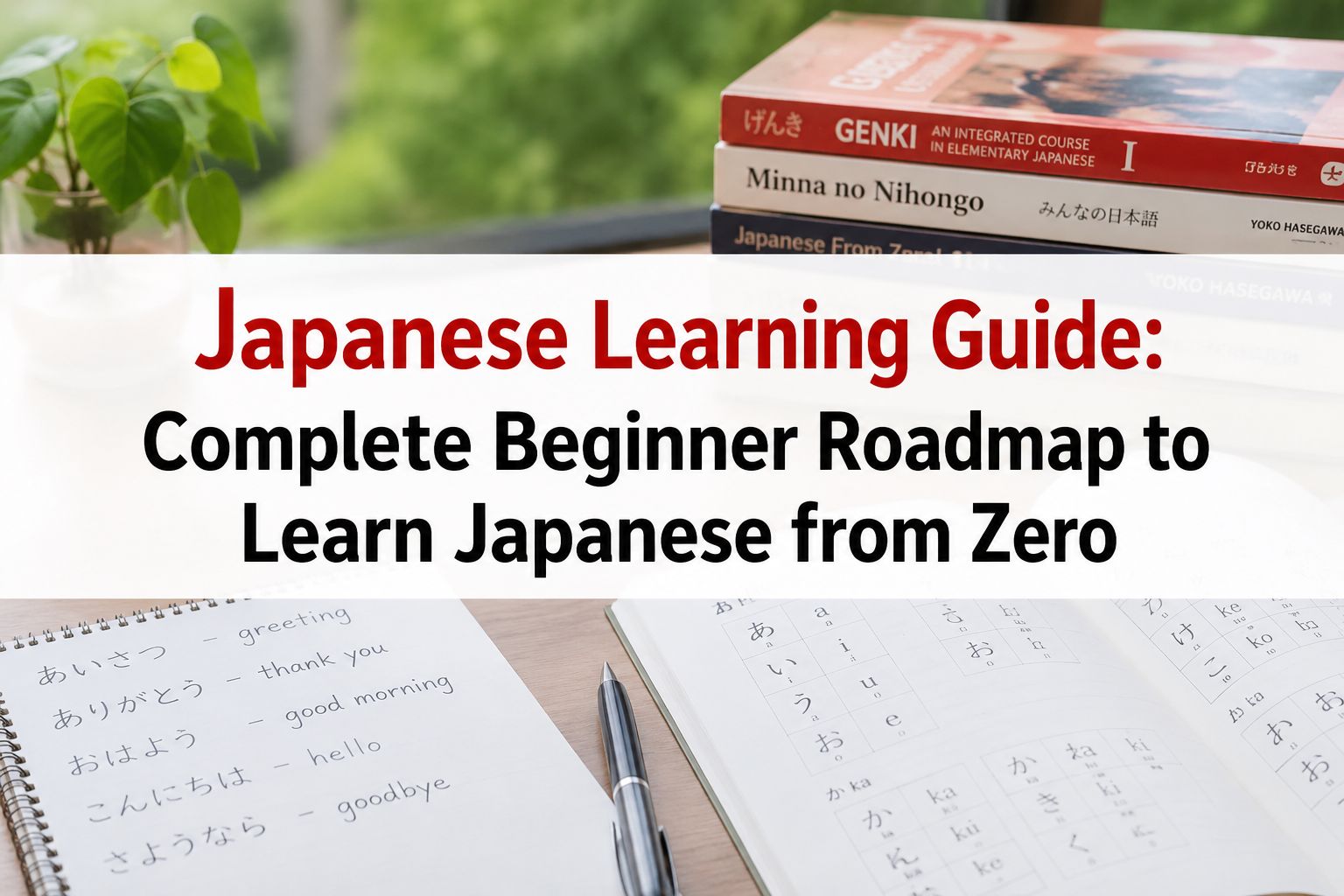
Choose a Japanese learning route from your current difficulty. Use reading, vocabulary, sentence practice, and scheduled reviews together, with a concrete next task.
This roadmap is for a complete beginner studying independently. The four-week schedule below is a starting plan, not a promise of fluency or a guaranteed exam result. Move more slowly whenever the examples still take effort to read or understand.
What to learn first
Step | Learn | Check that you can use it |
|---|---|---|
1 | Hiragana and katakana | Read familiar words without a romaji line |
2 | Noun sentences with です | Introduce yourself and identify an object |
3 | A few verbs in the ます form | Describe something you do |
4 | は, が, を, に, and で | Explain who, what, where, or when |
5 | Short listening and reading | Understand the same patterns in a new example |
6 | Review and personal sentences | Recall a pattern without copying the model |
Begin with the hiragana and katakana guide. Use romaji briefly to check a sound, then hide it when you practise reading. Kana is also the foundation for learning the readings of kanji.
A four-week beginner plan
Week 1: read kana and make a short introduction
Learn a small group of hiragana, read words that use it, and revisit those words the following day. Add katakana in manageable groups. A learner who needs longer than a week can extend this stage while still practising simple phrases.
Useful first sentences include:
Japanese | Reading | Meaning |
|---|---|---|
はじめまして。 | Hajimemashite. | Nice to meet you. |
わたしはアレックスです。 | Watashi wa Arekkusu desu. | I am Alex. |
学生です。 | Gakusei desu. | I am a student. |
よろしくお願いします。 | Yoroshiku onegaishimasu. | A polite expression used when beginning a relationship or introduction. |
The subject is understood in 学生です, so you do not have to repeat わたしは. Learn the sentence in its conversational setting, rather than expecting a separate English word for every Japanese word.
By the end of this stage, try a short introduction while looking only at a few cue words. Check the sound with reliable audio when you have it; romaji alone cannot show all aspects of Japanese pronunciation.
Week 2: put actions into sentences
Learn a few common verbs, such as 食べます (eat), 飲みます (drink), 読みます (read), 行きます (go), and 勉強します (study). Keep vocabulary tied to a sentence:
水を飲みます。 — I drink water.
本を読みます。 — I read a book.
日本語を勉強します。 — I study Japanese.
The verb usually comes at the end of a basic Japanese sentence. The particle を marks what an action directly affects. See basic Japanese sentence structure and the を lesson for more examples.
Choose words that fit your life. If you often drink coffee, コーヒーを飲みます is a useful sentence to recall. You can change the drink without relearning the whole structure.
Week 3: add places, people, and time
Compare these sentences carefully:
図書館にいます。 — I am at the library.
図書館で勉強します。 — I study at the library.
図書館に行きます。 — I go to the library.
The English word “at” does not decide the Japanese particle. The first sentence gives a location of existence, the second locates an activity, and the third gives a destination. Work through に and で when this distinction is unclear.
You can also add a time:
七時に起きます。 — I get up at seven.
毎朝、コーヒーを飲みます。 — I drink coffee every morning.
Specific clock times often take に. Expressions such as 毎朝, 今日, and 明日 normally do not need it. Learn these patterns from whole sentences.
Week 4: combine reading, listening, and recall
Read a short dialogue using patterns you have studied. First try to understand it without a translation. Then check unfamiliar words, listen if audio is available, and answer a few questions about the situation.
Finish by writing two or three sentences about yourself. Change the people, places, and objects from the model. This checks whether you can use the pattern in a new context.
At this point, begin learning common kanji inside words you already know. For example, connect 水 with みず and the sentence 水を飲みます. Learning an isolated English gloss does not tell you every reading or use of a kanji.
Choose a daily routine you can repeat
Time available | Review | New learning | Use it |
|---|---|---|---|
15 minutes | Recall yesterday's words for 5 minutes | Read one short explanation for 5 minutes | Say or write two sentences for 5 minutes |
30 minutes | Review for 5 minutes | Study one pattern and its examples for 10 minutes | Read or listen for 10 minutes, then write for 5 |
60 minutes | Review for 10 minutes | Study for 15 minutes | Read and listen for 20 minutes, then practise and correct for 15 |
These are sample allocations. If an explanation takes longer, reduce the amount of new material. Keep a small review task even on a busy day. The study routine guide gives more ways to arrange a session.
Use a small set of resources
Start with one main course, a dictionary, and a way to review vocabulary. A beginner course gives you a sequence; a dictionary resolves a word; review helps you recall it later. Adding several apps that do the same job can make it harder to see what you have actually learned.
Choose examples with clear explanations and translations. If you use flashcards, include a useful word or sentence and a reading you can check. Avoid treating a streak or a high recognition score as proof that you can produce the sentence yourself.
Check your understanding
Try these before reading the answers.
Put these parts into a natural simple sentence: 飲みます / 水を.
Choose the particle for “I study at the library”: 図書館(に・で)勉強します。
Choose the particle for “There is a cat in the room”: 部屋(に・で)猫がいます。
Introduce yourself using your own name and です.
Write one action sentence about your day. Add an object or a place if you can.
Answers and explanations
水を飲みます。The object phrase comes before the verb.
図書館で勉強します。で marks where studying takes place.
部屋に猫がいます。に marks the location of existence with います.
わたしは[名前]です。is one possible answer. In an introduction, [名前]です。can also be enough.
Answers vary. For example, カフェで本を読みます means “I read a book at a café.” カフェで locates the activity and 本を identifies what you read.
Where to go next
If kana is still slow, return to the kana reading practice. If sentence order is confusing, study basic sentence structure. If you can make short sentences but struggle with particles, compare は and が and に and で.
The N5 grammar list organizes the beginner lessons available here. Use the level label as a guide to study; this list does not claim to be an official, exhaustive JLPT syllabus.
Choose your next task from a difficulty you can name
A study plan becomes useful when a wrong answer changes the next task. If you can read words but cannot explain what a sentence says, another kana chart is unlikely to solve that specific difficulty. Try a short passage and identify the word or relationship that blocked understanding.
What happens | A useful next task | What to check afterwards |
|---|---|---|
You confuse yesterday and tomorrow | Time-word retrieval | Choose the intended day in a fresh message |
You know the words but miss a changed time | Read a notice with an exception | State the final departure and arrival deadline |
You choose a particle from the place noun alone | Location-particle practice | Explain the difference between existence and action |
You can answer immediately but forget tomorrow | A scheduled review | Retrieve the answer before opening the explanation |
Use a single small task today, then add another only if it fits your time. The daily learning page can schedule questions you have practised. It does not replace reading, listening, or conversation, and a completed set is not evidence that every related skill is secure.
After a week, return to a different passage in the same category. Record whether you needed a translation, a dictionary, or a model answer. That gives you a more useful comparison than rereading a passage you now remember.
Practise the next step
Try what you have just read
Recognise the pattern, write an answer from memory, then use it in a short reading. Your existing progress carries over.
Open the three-step lessonSources
Related Grammar
Japanese Te-Form: Conjugation Table, Uses, and Practice
The te-form connects a verb to another action or to an ending such as ください. It is not a past ending. First identify the verb group, then apply its sound change.
Wa vs Ga: Topic, Subject, Contrast, and Practice
Use context to choose between は and が. は establishes what you are talking about or sets up a contrast. が can identify the person or thing that supplies the answer. Translating both as the English subject hides this difference.
The Japanese Particle を: Objects, Contrasts, and Practice
を often marks what an action acts on: 本を読みます and 水を飲みます. It also marks routes and places left behind with some movement verbs, so translating every を phrase as a direct object is too narrow.
に
に (ni) points to a specific time, destination, location of existence, or person related to an action. It is one of the most important N5 particles.
で
で (de) marks where an action happens or what means, tool, or language is used. It is different from に, which often marks existence or destination.
Arimasu vs Imasu: Existence, Location, and に vs で
Use あります to describe ordinary objects and plants, and います for people and animals in the basic existence pattern. 木があります is therefore normal even though a tree is alive.
Related Articles
Japanese Time Words: Today, Tomorrow, Last Week, and Next Week
Learn time expressions as a connected set, then use them in short plans. The contrast between 昨日 and 明日 is more useful when you can also choose an appropriate verb ending.
Japanese Reading Practice: A Train Notice with a Changed Departure Time
Read a short fictional station notice and distinguish the original departure from the replacement time. Use the final instruction to decide when to arrive.
Ni vs De Location Practice: Where Things Are and Where Actions Happen
Use に for the location of existence and で for the place an action happens. Practise the distinction with the same room, shop, and library vocabulary.
How to Start Japanese: Your First Seven Days with Practical Checks
Start Japanese with a seven-day sequence of kana, short sentences, time words, and practical reading. Each day ends with a small task you can actually check.
Hiragana and Katakana: Charts, Reading Rules and Practice
Read kana as sound sequences, including small っ and long vowels. Use a chart, contrast words, and transfer the skill to a short menu or message.
Japanese Sentence Structure: Word Order, Particles and Practice
Build Japanese sentences by identifying the predicate, actor, object, place, and time. Compare particle choices and test them with short typed answers.