First introductions: names, background and questions
Introduce your name and background, then ask the other person a polite question.
Try 8 questions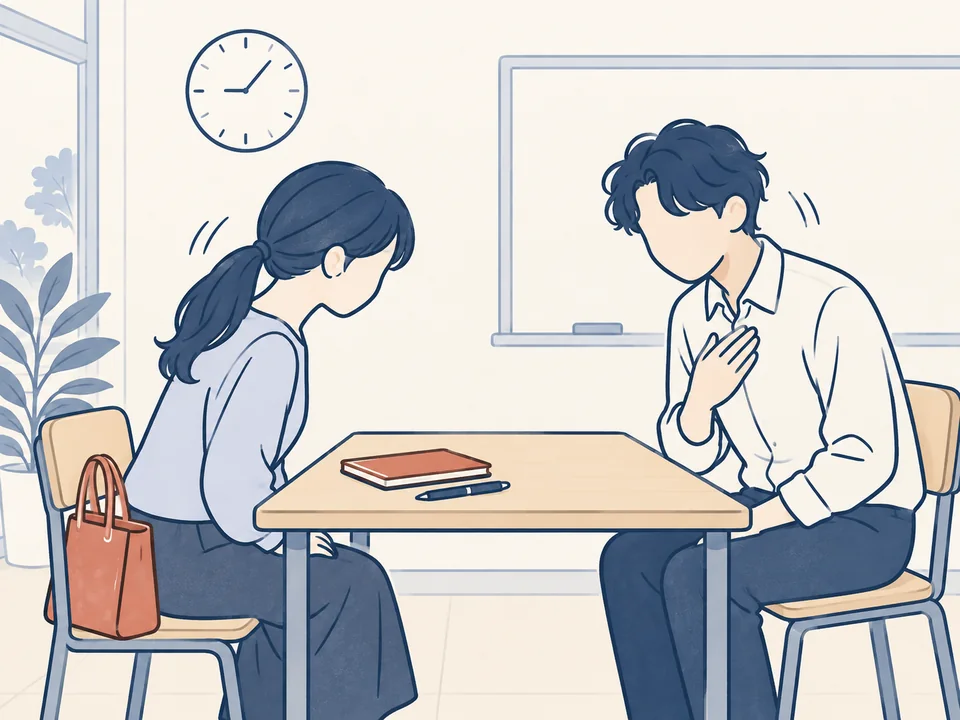
Read the text
- 1
はじめまして。メイです。
- 2
ミャンマーから来ました。学生です。
- 3
田中です。よろしくお願いします。
- 4
田中さんも学生ですか。
Briefly introduce your name and role
Begin a first meeting with はじめまして. Add です after your name: メイです. Do not add さん to your own name; use it when addressing someone else, as in 田中さん.
In 私は学生です, 私は introduces yourself as the topic. When it is already clear who you mean, 学生です is enough. You need not repeat 私は in every sentence.
Say where you came from
ミャンマーから来ました says you came from Myanmar. から marks the starting place. 来ました(きました) is past; 来ます(きます) has a different time meaning.
出身はミャンマーです can state your home country. An introduction does not need to include your country, address, job and age every time. Here, practise your name, country and being a student.
Ask about the other person
も in 田中さんも学生ですか means “also”. After saying you are a student, you ask if Tanaka is one too. Use 田中さんは学生ですか without suggesting that shared fact.
If asked, answer はい、学生です if you are a student, or いいえ、学生ではありません if you are not. よろしくお願いします is a polite expression for closing a first introduction.
Common mistakes
Incorrect expression
私はメイさんです。
Corrected expression
私はメイです。
Do not add さん to your own name.
Incorrect expression
学生だです。
Corrected expression
学生です。
Do not combine だ and です.
Incorrect expression
学生です。か
Corrected expression
学生ですか。
Put か before the final punctuation to make the polite question.
Try 3 questions
Practise without an account. Sign in to sync your results and review schedule.
Loading your history…
Loading your history…
History and self-check answers
The answers below are for self-study and do not record a score. Mixed practice uses topics you have practised.
Recorded questions in this set: 0
Correct on first attempt: 0