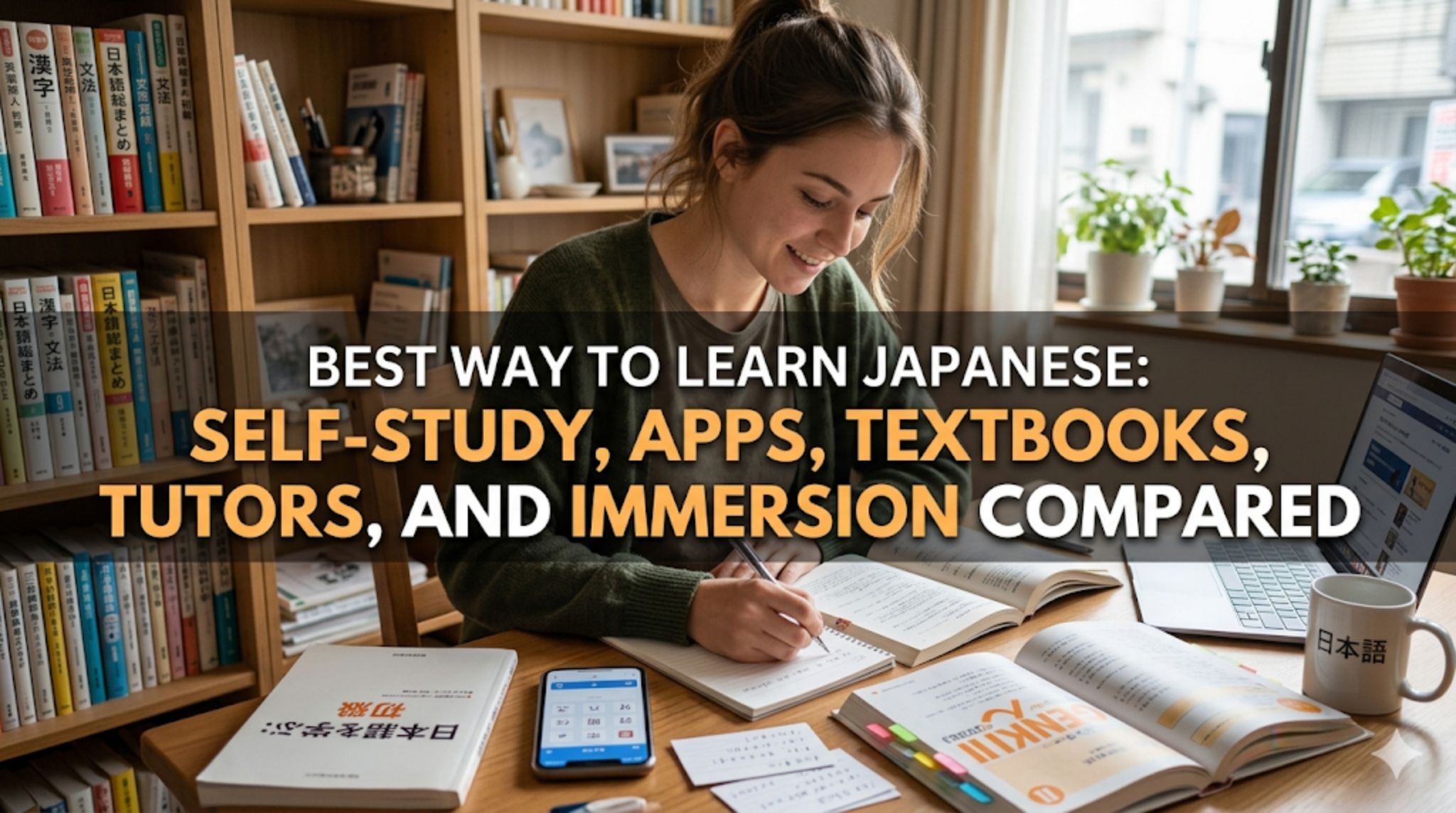
The best way to learn Japanese depends on your goal, schedule, budget, and learning style.
There is no single perfect method.
Self-study, apps, textbooks, online courses, tutors, language exchanges, and immersion all have strengths. They also have weaknesses.
The strongest beginner strategy is usually a structured combination. You need understanding, practice, feedback, and review.
Conclusion - Key Points
The best way to learn Japanese is a balanced system, not one tool.
Self-study is flexible but needs structure.
Apps are convenient but can be too passive.
Textbooks give order but need extra output practice.
Tutors and classes provide feedback but require review.
Beginners should choose tools based on goals: conversation, reading, JLPT, travel, or daily habit.
Main Content
What best means for Japanese learners
Best does not mean most popular.
It means the method helps you do the next important task.
For beginners, the next important tasks are:
read kana,
understand simple sentences,
use basic particles,
build a study habit,
produce short output,
review consistently.
A method is good if it helps these tasks.
A method is weak if it only feels entertaining but does not improve usable skill.
Method 1: self-study
Self-study is common because it is flexible and low cost.
Strengths:
You choose your pace.
You can study anytime.
You can focus on your goal.
It is affordable.
Weaknesses:
You may choose the wrong order.
You may skip output.
You may not notice mistakes.
You may restart often.
Best for:
disciplined learners,
budget-conscious learners,
learners with irregular schedules.
How to make self-study work:
follow one roadmap,
keep a sentence notebook,
review weekly,
test yourself with output.
Example self-study task:
Learn NをVます.
Then write:
水を飲みます。
本を読みます。
日本語を勉強します。
Method 2: apps
Apps are useful for daily contact.
Strengths:
easy to start,
good for habit,
useful for vocabulary review,
quick feedback,
mobile-friendly.
Weaknesses:
can become passive,
may overuse multiple-choice answers,
may not explain grammar deeply,
may not develop speaking enough.
Best for:
beginners building consistency,
vocabulary review,
short daily sessions.
How to use apps well:
do not make apps your only method,
write original sentences after lessons,
read examples aloud,
review mistakes outside the app.
Example app extension:
After learning 飲みます, write:
コーヒーを飲みます。
朝、水を飲みます。
Method 3: textbooks or structured courses
Textbooks and courses provide sequence.
Strengths:
clear progression,
grammar explanations,
exercises,
reading practice,
often include audio.
Weaknesses:
can feel slow,
output may still be limited,
learners may read explanations without practicing,
some examples may not match your personal goals.
Best for:
beginners who want structure,
JLPT learners,
learners who like a curriculum.
How to use textbooks well:
do every exercise actively,
read examples aloud,
rewrite examples with your own words,
review old chapters.
Example:
Textbook pattern:
NはNです
Your version:
わたしは日本語の学生です。
Method 4: tutors and classes
Tutors and classes add feedback.
Strengths:
correction,
speaking practice,
accountability,
personalized explanations,
real interaction.
Weaknesses:
more expensive,
schedule dependent,
progress can be slow without review,
lessons may not replace self-study.
Best for:
conversation goals,
learners who need accountability,
learners who want correction.
How to use tutoring well:
Before the lesson:
prepare 5 sentences.
During the lesson:
ask for corrections.
After the lesson:
rewrite corrected sentences.
Example preparation:
わたしは会社員です。
毎日、日本語を勉強します。
週末に友だちと映画を見ます。
Method 5: immersion and native content
Immersion is powerful, but beginners need to use it carefully.
Strengths:
natural rhythm,
real vocabulary,
motivation,
cultural context.
Weaknesses:
can be too difficult,
may create passive watching,
grammar may be unclear,
progress can feel invisible.
Best for:
motivation,
listening exposure,
learners with a basic foundation.
Beginner-friendly immersion:
children’s songs,
short beginner videos,
graded readers,
slow dialogues,
kana subtitles.
Do not make native-level content your only study source at the beginning.
Comparison table
| Method | Best use | Main risk | Beginner fix | |---|---|---|---| | Self-study | flexible progress | no structure | follow one roadmap | | Apps | daily habit | passive answers | write sentences after lessons | | Textbooks | grammar order | reading without output | do substitution drills | | Tutors | feedback | no review | rewrite corrections | | Immersion | motivation | too difficult | use beginner content |
Best beginner study stack
A strong beginner stack can be simple.
Option A: low-cost self-study
kana chart,
beginner textbook or course,
vocabulary app,
sentence notebook,
weekly review.
Option B: conversation-focused
beginner course,
tutor once per week,
daily audio repetition,
short speaking recordings,
correction notebook.
Option C: JLPT-focused
structured grammar course,
vocabulary review,
reading practice,
quizzes,
monthly progress test.
Option D: travel-focused
kana basics,
survival phrases,
polite requests,
listening practice,
role-play.
How to choose your method
Ask five questions.
What is my goal?
Examples:
conversation,
reading manga,
JLPT,
travel,
school,
work.
How much time do I have?
Examples:
15 minutes a day,
30 minutes a day,
2 hours on weekends.
Do I need feedback?
If you want conversation, feedback helps early.
Do I need structure?
If you restart often, choose a course or textbook.
Can I produce sentences?
If not, add writing or speaking drills immediately.
Mini exercise: design your Japanese stack
Choose one item from each category.
Structure:
textbook,
online course,
guided curriculum.
Review:
app,
flashcards,
notebook.
Output:
sentence writing,
voice recording,
tutor,
language exchange.
Organization:
weekly review page,
mistake list,
progress tracker.
Example stack:
Course for grammar
App for vocabulary
Notebook for sentences
Weekly review for mistakes
Tutor twice a month for speaking
That is a complete beginner system.
Sources
Related Articles
Japanese Learning Guide: Complete Beginner Roadmap to Learn Japanese from Zero
A complete beginner roadmap for learning Japanese from zero, covering kana, basic grammar, study routines, mistakes, methods, and realistic goals.
Japanese Learning Mistakes: Beginner Errors That Slow Your Progress
A detailed guide to common Japanese learning mistakes beginners make, including resource overload, app-only study, romaji, particles, and review.
How Long to Learn Japanese: Realistic Timelines for Beginners
A realistic timeline guide for Japanese beginners, covering the first week, one month, three months, six months, and goal-based study planning.
How to Start Japanese: A 7-Day Plan for Absolute Beginners
A practical first-week Japanese plan for beginners, covering kana, greetings, basic sentences, daily practice, and review.
Hiragana and Katakana Guide: Learn Japanese Kana the Smart Way
A beginner-friendly guide to hiragana and katakana, including differences, learning order, tricky kana, reading drills, and daily practice.
Japanese Study Routine: Daily Beginner Plans for 15, 30, and 60 Minutes
A practical Japanese study routine for beginners, with daily and weekly plans for kana, grammar, vocabulary, output, and review.